



Key Takeaways on Apartment Buyout Agreements
- An apartment buyout agreement is the document that makes a buyout legally binding, once signed, your rent-stabilized tenancy ends.
- Six terms must be clearly spelled out: payment amount, payment date, move-out date, security deposit return, final rent date, and release of claims.
- The landlord is required by law to file the executed agreement with HPD within 90 days.
- A landlord's signing deadline is not a legal requirement. You are entitled the time to review.
- If you receive an offer letter before the agreement, do not respond with a number or a timeline, confirm receipt only.
When a landlord makes a buyout offer on a rent-stabilized apartment in NYC, a formal document eventually follows. That signed document, the apartment buyout agreement, sometimes called a surrender agreement or buyout addendum, is where the negotiation stops being informal and starts being binding.
Lease Buyout Advisors works with NYC tenants at this stage. Below, we break down what a buyout agreement should contain and which clauses most tenants overlook before they sign.
What Is an Apartment Buyout Agreement?
An apartment buyout agreement is a formal written contract in which you agree to vacate your apartment by a specified date and the landlord agrees to pay you a specified amount. It is the final, binding stage of an apartment lease buyout. In NYC rent-regulated buildings, it also functions as a surrender of your tenancy including rent stabilization protections and any succession rights attached to the unit.
This surrender is permanent. A market-rate tenant giving up a lease loses a rental. A rent-stabilized tenant giving up a lease loses a protected tenancy that may have taken decades to build and cannot be recovered. Aim to sign for the number you negotiated up to, not the one the landlord opened with.
Under Local Law 102 of 2019, landlords in NYC are required to electronically file the executed buyout agreement with the Department of Housing Preservation and Development (HPD) within 90 days of signing. Failure to do so results in a violation for the owner, not the tenant.
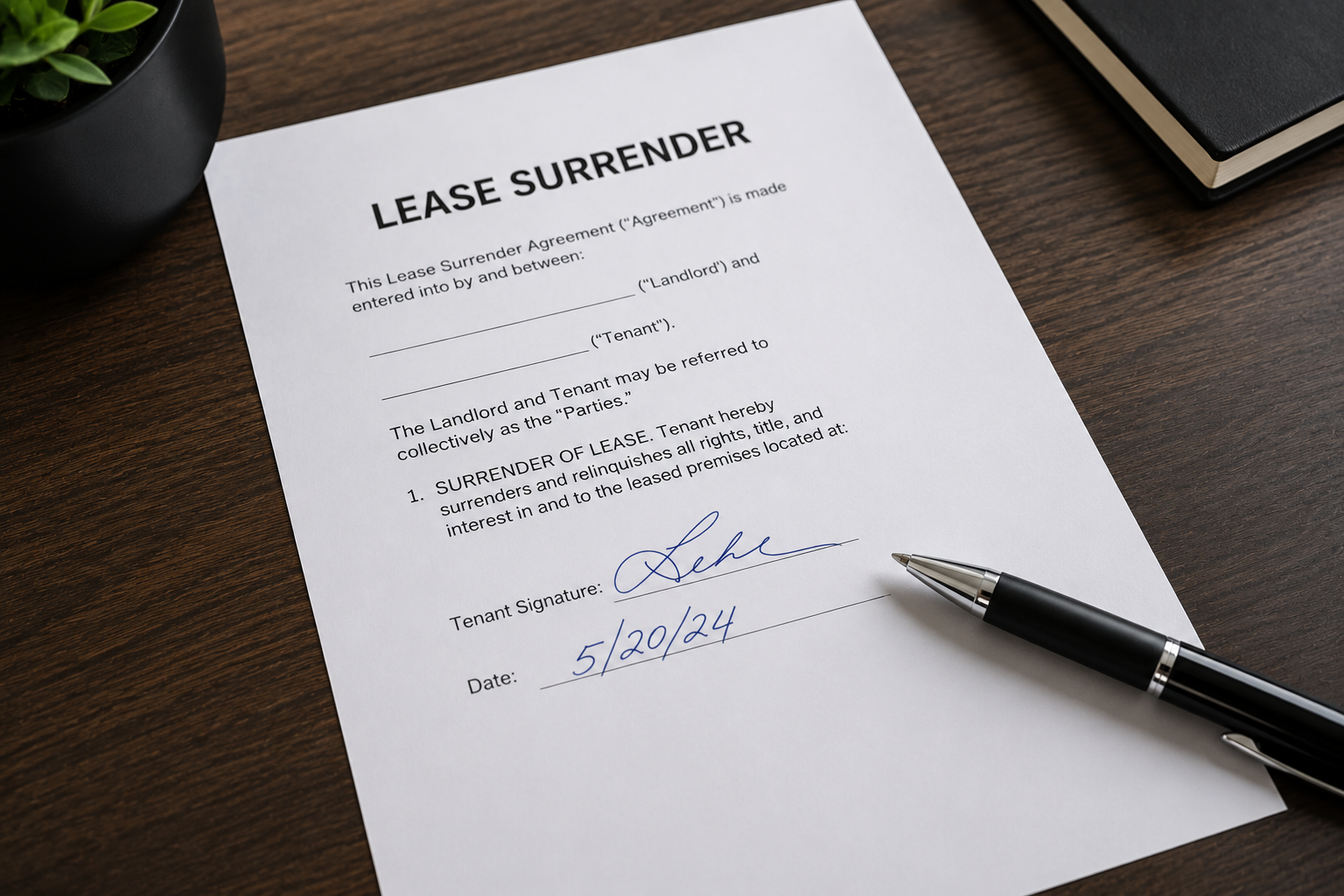
Apartment Buyout Agreement Clause Checklist
Before signing any apartment buyout agreement, confirm that each of the following is clearly stated in the document, not just discussed verbally. Use this as a reference when reviewing what you have been sent.
1. Payment amount. The exact dollar figure. Not a range, or "an amount to be agreed on" - the specific number you negotiated. If this does not match what was discussed, do not sign.
2. Payment method and date. How you will receive the payment (certified check or wire transfer) and the specific date it will be delivered. Vague language like "upon vacating" is not acceptable. Tie it to a date.
3. Move-out date. The agreed date by which you will vacate and return the keys, and the date your rent obligation ends. 90 to 180 days from signing is a reasonable range to negotiate. Do not let the landlord compress this without compensation.
4. Security deposit return. Addressed separately from the buyout payment. Confirm the amount, who holds it, and the timeline for return. It should never be folded into the buyout figure.
5. Full release of claims. The landlord releases you from all further obligations related to the tenancy. Read this one carefully as releases can be written broadly, and you want to know whether you are giving up the right to pursue any pre-existing complaints against the landlord. Your tenant rights do not disappear just because a buyout is on the table.
6. Confidentiality. A clause preventing either party from publicly disclosing the terms. Standard in most buyouts and in your interest as a tenant.
7. Vacating condition requirements. If the agreement specifies the condition you must leave the apartment in, ensure the language is specific. Open-ended language here can be used against you after you have already left.
8. Default provisions. What happens if the landlord does not pay on time? The agreement should specify consequences for non-payment, not only for your failure to vacate.

Buyout Agreement Letter for a Rent-Stabilized Apartment: Sample Response
When a landlord opens a buyout, the first thing you receive is often a letter rather than a formal agreement. A typical buyout agreement letter for a rent-stabilized apartment includes the proposed payment amount, a suggested move-out date, and sometimes a deadline to respond. Under NYC rules, it should also state clearly that you have the right to decline, the right to seek advice, and the right to stay in your apartment.
What it will not contain is any sense of what the offer is actually worth relative to your unit. That figure is set to benefit the landlord, and the letter is written to make it look reasonable. Treat it as an opening position, not a final number.
In many cases, a landlord will send an offer letter before a formal agreement is drafted. This letter is not the agreement, it is an opening position. You are not obligated to respond on their timeline, and the number it contains is not fixed.
The most common mistake tenants make at this stage is responding too quickly. Either by accepting informally, revealing too much about their situation, or naming a counter figure before they understand what the apartment is worth.
If you want to confirm receipt without committing to anything, here is a sample response. This is illustrative only, every buyout situation is different, and you should review any correspondence with a professional before sending.
──────────────────────────────────────────────────
Dear [Landlord's Name / Management Company],
I am writing to confirm receipt of your buyout offer dated [date] for the apartment at [address], Unit [X].
I am reviewing the offer and will respond in due course. Please direct all further correspondence regarding this matter to me in writing.
Sincerely,
[Your Name]
[Your Address]
[Date]
──────────────────────────────────────────────────
Sample disclaimer: This letter is provided as a general illustrative example only. It is not a legal document and does not constitute legal advice. Do not rely on this sample without first speaking to a qualified professional about your specific situation.
What this letter does: it buys you time without tipping your hand. It does not mention a counter figure, a timeline preference, or anything about your housing situation. Before you respond with anything more substantive, find out what your apartment is worth to the landlord, because that is what your counter should be built around.

What to Do Before You Sign the Agreement
A landlord's signing deadline is not a legal requirement. If you are being pushed toward a date that does not give you enough time to review the agreement properly, that pressure is a tactic. Slow down.
Read the full document against the checklist above. If the payment figure, move-out date, or any term differs from what was discussed, raise it before signing, not after. Verbal agreements do not override what is written.
What looks standard in an apartment lease buyout agreement form can contain terms that reduce what you walk away with or create obligations you did not expect. The scope of the release clause and the vacating conditions are where tenants most often get caught out. If the terms aren't right, you change them by negotiating the lease buyout with the landlord.
Get Your Agreement Reviewed Before You Sign
At Lease Buyout Advisors, we review what the agreement contains, or is missing, and whether the number reflects what your apartment is worth to the landlord. We handle the negotiation so that by the time the document lands in front of you, the terms are ones you pushed for, rather than what the landlord set.
If a buyout offer or agreement has arrived, contact Lease Buyout Advisors at 212-655-9851 before you respond.
Disclaimer: This guide is for general informational purposes only and does not constitute legal advice. Housing laws can vary, and your rights may depend on your specific situation. For legal guidance, speak with an attorney or a tenant support organization.
FAQs on Apartment Buyout Agreements in NYC
What is a buyout agreement for an apartment?
A lease buyout agreement for an apartment is a binding contract in which a tenant agrees to vacate in exchange for a payment from the landlord. In NYC rent-regulated buildings, it is also a formal surrender of the tenancy and all protections that come with it.
Is there a standard DHCR buyout agreement form?
There is no official DHCR buyout agreement form issued to tenants or landlords. The agreement is drafted between the parties. What the law requires is that the landlord file the executed agreement with HPD within 90 days of signing but the document itself has no state-issued template.
What are the most important apartment buyout clauses to check?
The clauses that most often cause problems are the release of claims, the vacating condition requirements, and the default provisions. Payment amount, date, and move-out timeline are the ones tenants focus on, but the clauses listed above are where disputes tend to arise after signing.
Can a landlord change the terms after both parties sign?
No. Once both parties have signed the buyout agreement, neither can unilaterally change its terms. Any modification requires a new written agreement signed by both parties. Do not accept verbal changes after signing.
What happens if the landlord doesn't pay after the agreement is signed?
Non-payment after a signed buyout agreement is a breach of contract. This is why the agreement must specify payment method, exact date, and consequences for non-payment.


